How National and World Championship Titles Are Earned
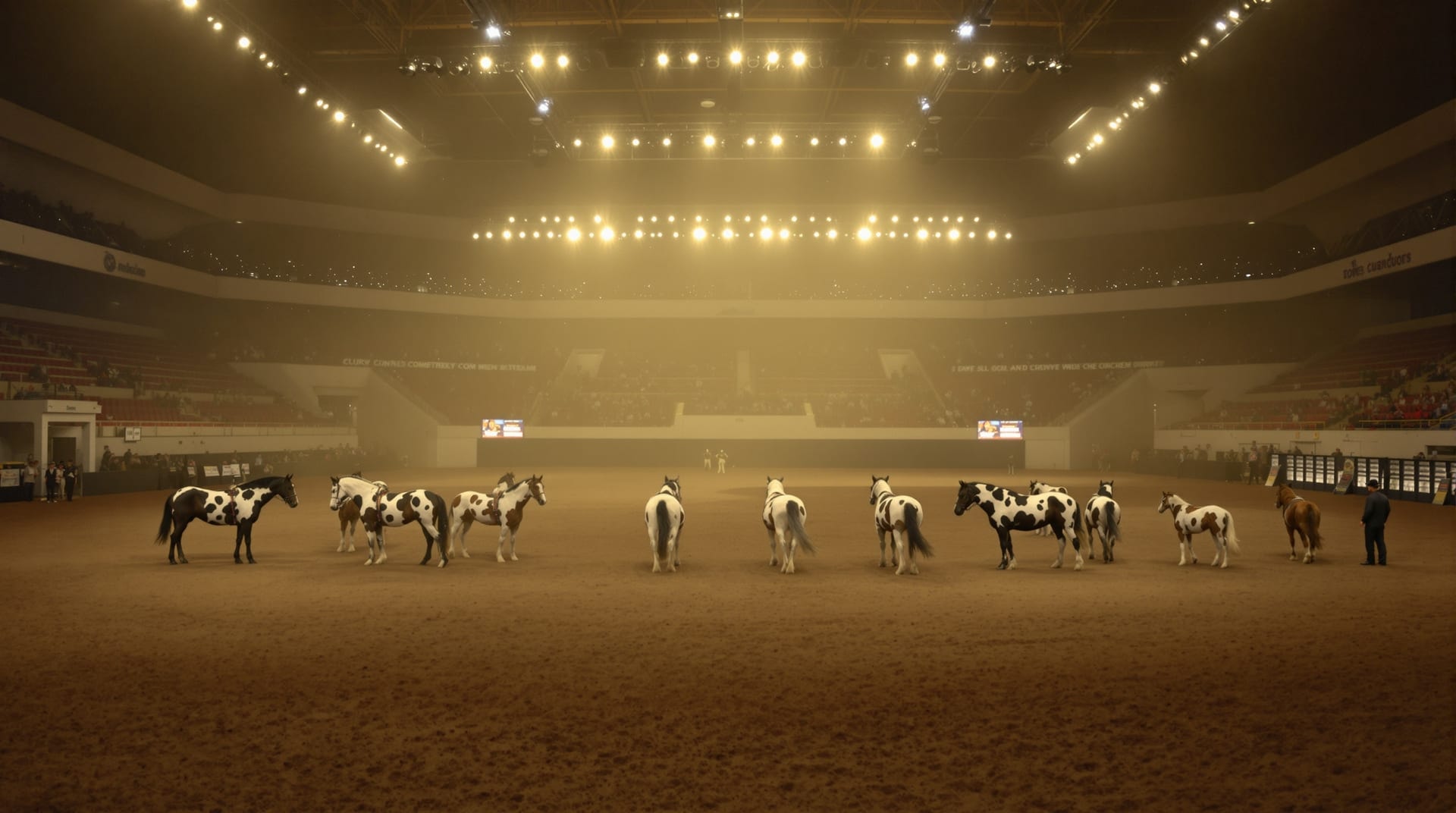
The phrase "world champion" appears in almost every show horse advertisement, and it means several different things depending on where it was won, in what division, and against how many horses. Understanding the structure behind the title is the difference between reading an advertisement and evaluating one.
This page describes how breed championship showing is organised in general terms. Rules, class lists, qualification requirements and division definitions are set by the Appaloosa Horse Club and are revised between years — treat the registry's current published rulebook as authoritative and this page as orientation.
The Shape of the Competitive Year
Breed showing is a pyramid. Most competition happens at local and regional shows run by affiliated clubs across the year. These shows award points, build records, and function as the proving ground where a horse and rider learn their job. Above them sit the breed's premier events — the National Show and the World Championship Show — which draw entries from across the country and internationally, and where the titles that appear in advertisements are awarded.
That structure means a championship is not just a win on a day. It is the end of a season of qualifying, hauling, and consistent performance under a range of judges, which is why exhibitors treat national and world titles as a different order of achievement from a regional win.
Divisions: Open, Non-Pro and Youth
The single most important qualifier in any championship claim is the division it was won in.
- Open — anyone may exhibit, including professional trainers. Open classes are typically the deepest and most competitive, because the horses are shown by the people who ride for a living.
- Non-pro (sometimes amateur) — restricted to exhibitors who do not train, show or work with horses for compensation, under the registry's published definition. A non-pro title is won against other amateur riders on their own horses.
- Youth — restricted by the exhibitor's age, with sub-divisions by age bracket. Youth competition is where a large share of the breed's participation actually sits.
These are genuinely different achievements, not tiers of prestige, and a record should always be read with the division attached. A non-pro world championship says something about the horse's trainability and suitability for an amateur rider that an open title does not, and vice versa. Our page on youth and non-pro divisions covers this in more depth.
Champion, Reserve, Grand and Res-Grand
Within a class, the champion is the winner and the reserve champion is second. In halter, an additional layer applies: individual age and sex classes feed into a grand championship, so that the winners of each class return to compete for grand champion and reserve grand champion of their sex. A grand champion title therefore sits above a class win and reflects a horse that beat its own age group and then the winners of every other age group.
This is why a "national grand champion" and a "national champion" are not interchangeable, and why substituting one for the other in an advertisement is a meaningful misrepresentation rather than shorthand.
What Championship Records Do Not Tell You
Three limitations are worth holding on to. First, class size varies enormously, and a title won against four horses and one won against forty are not equivalent achievements even though they read identically on paper. Second, judging is by definition an opinion; multi-judge formats reduce the variance but do not eliminate it. Third, a championship describes a horse on a given day in a given condition, and horses change.
None of this makes championship records worthless. It makes them evidence to be weighed rather than a number to be added up — the theme of our companion page on reading a show record.
Producers and Producing Records
The breed also recognises horses whose offspring have earned titles, which is where terms like "champion producer" originate. For a breeder this is often the more relevant statistic, because it describes what a horse transmits rather than what it did itself. When evaluating a breeding stallion, ask how many titled offspring, out of how many total foals, over how many seasons — a producing record without a denominator is not a record.
Reading Historical Results
Individual placings can identify private clients, including youth exhibitors, so this page does not list them. It instead explains the championship structure needed to interpret a historical results sheet.