Conformation and Movement in the Halter Ring
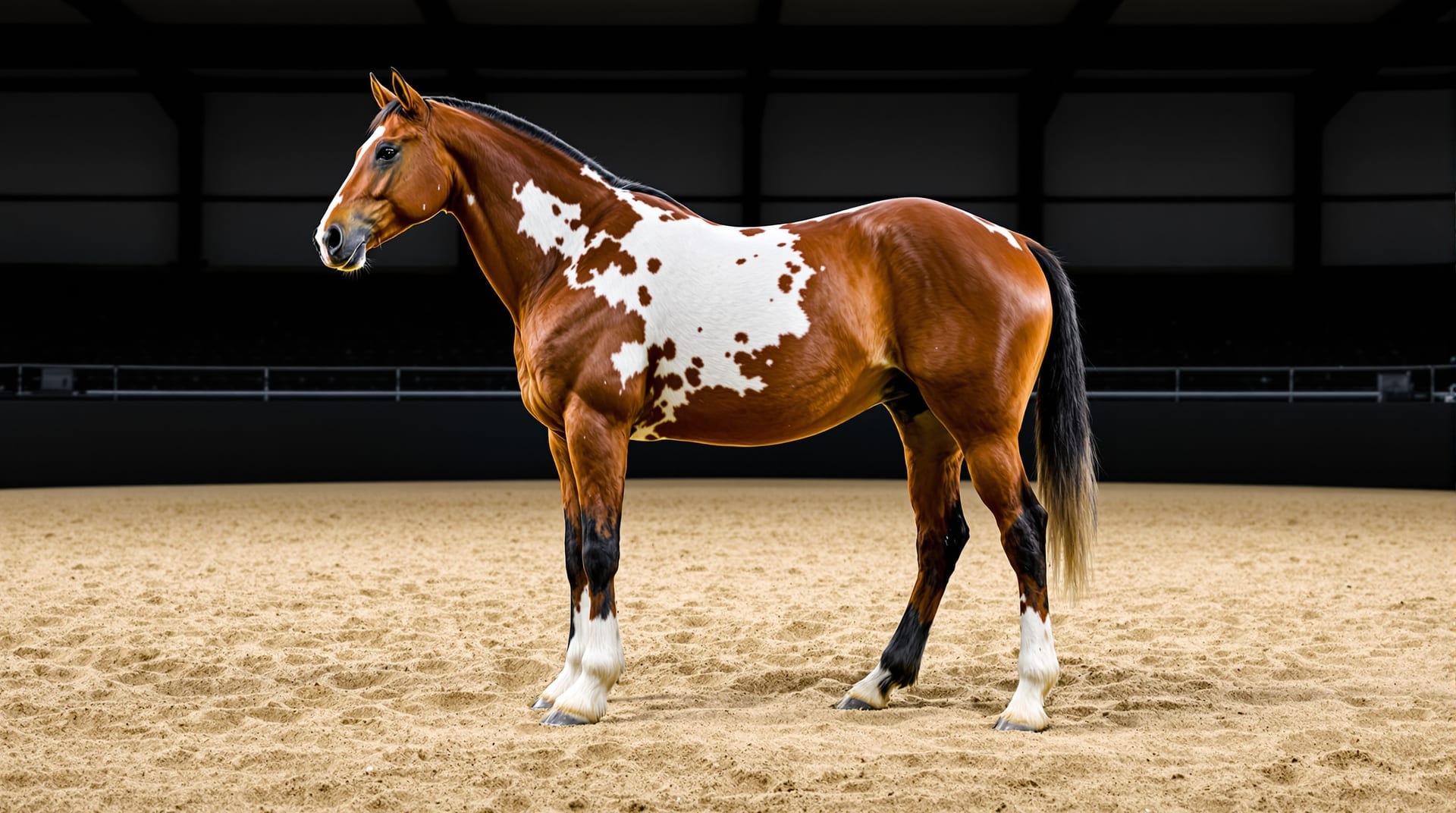
Halter is the oldest class on the show bill and the most misunderstood. Spectators watch a line of horses standing still and assume the judging is a beauty contest. In fact halter is the one class where a horse is evaluated purely on how it is built — and building is what determines whether it stays sound doing anything else. A halter placing is a structural opinion delivered in public.
Balance First
Experienced judges assess balance before anything else, because balance governs everything downstream. A balanced horse divides roughly into equal thirds — shoulder, barrel, hindquarter — with a topline that reads as proportionate rather than as a long back grafted onto a short hip. Height at the withers and height at the croup should be broadly level; a horse that stands markedly downhill will carry weight onto the forehand in every discipline it attempts.
Balance is also what makes a horse look larger or smaller than the tape says. A well-proportioned 15-hand horse frequently reads bigger in the ring than a poorly proportioned 15.3-hand one, which is why judging by eye and judging by measurement disagree so often.
Structural Correctness
The legs carry the horse's career. Viewed from the front, the leg should drop in a straight column from the point of the shoulder through the knee, cannon and fetlock to the centre of the hoof. Deviations — toeing in or out, offset knees, base-narrow or base-wide stance — load joints unevenly and appear later as unsoundness. From the side, the pastern should share the slope of the shoulder; too upright transmits concussion, too long and sloping strains the supporting structures.
Behind, the hock is the joint that carries the most conversation. Excessive angulation, described as sickle-hocked, and insufficient angulation, described as post-legged, both compromise the hindquarter's ability to engage. Judges look for a hock set under the horse with an angle that lets the hind leg reach forward without strain.
Muscling and Type
Appaloosa halter horses are evaluated for muscle that is proportionate and functional rather than merely large. Muscling should tie in smoothly — a forearm that blends into the shoulder, a gaskin that blends into the stifle — rather than appearing bolted on. Definition without smoothness reads as a horse built for a photograph rather than a career, and the modern standard across stock breeds has moved back toward athletic proportion for exactly that reason.
Breed type sits alongside muscling. In the Appaloosa ring, the registry's characteristics — mottled skin, visible sclera, striped hooves — are what make the horse recognisably of the breed. Type does not outrank structure, and no judge should be placing pattern over correctness, but a horse that is both correct and typey has an advantage over one that is merely correct.
The Head and Neck
The head is evaluated for proportion, refinement and expression: a clean throatlatch, a generous eye, and width between the jaws that leaves room for flexion. The neck should tie into the shoulder well and come out of the top of the shoulder rather than low, because a neck set low limits how the horse carries itself under saddle. Length matters less than attachment — a shorter neck attached well is more useful than a long one attached badly.
Movement
Horses are shown at the walk and trot in hand, and movement can change a class. The walk should be flat-footed and purposeful, tracking straight. At the trot, judges look for a straight, true stride with a length appropriate to the horse's build. Common faults are winging in or out, paddling, forging and interference — each of which indicates something about how the horse is put together below the knee and hock.
Straightness matters more than knee action in stock-breed halter. A horse that trots dead straight and covers ground efficiently will out-place a flashier one that swings a foot, because the swinging foot is a structural report on the leg above it.
Observe the Horse Before the Set-Up
The formal stance is only one view. Watch the horse enter, turn and return to the line before studying the final pose. A handler can place the feet, but unscripted steps reveal balance and straightness in both directions. Stand where the horse can travel towards, away from and across your view.
Compare both sides without expecting symmetry. Ask whether the shoulder, barrel and hip look proportionate when the horse is relaxed, and whether the neck joins the body once the head is no longer held for the judge. Watch transitions too. The first stride from halt and the return to walk can expose hurried foot placement that a steady trot conceals.
Photographs help when revisiting proportions, but perspective can exaggerate a head, shorten a back or alter the set of a leg. Keep the camera near the middle of the body, use a level view and treat a frame as a prompt for another look, not a verdict.
Presentation
Presentation cannot substitute for structure, but poor presentation can hide it. Fitness and condition, an appropriate clip, a horse trained to stand square without fussing, and a handler who shows the horse rather than themselves are all part of what a judge is actually able to see. Many placings turn on whether the horse's best angle was ever presented at all.
Applying This as a Buyer
If you are evaluating a sale prospect, look at balance and legs before pattern, colour or pedigree, and look at the horse loose in a pen as well as in hand. Have a veterinarian examine anything you intend to campaign. A structural fault does not always end a career, but you want to be the person who priced it in rather than the person who discovered it. The American Association of Equine Practitioners publishes guidance on what a purchase examination covers and how to work with your veterinarian on one.