Weanlings and Yearlings
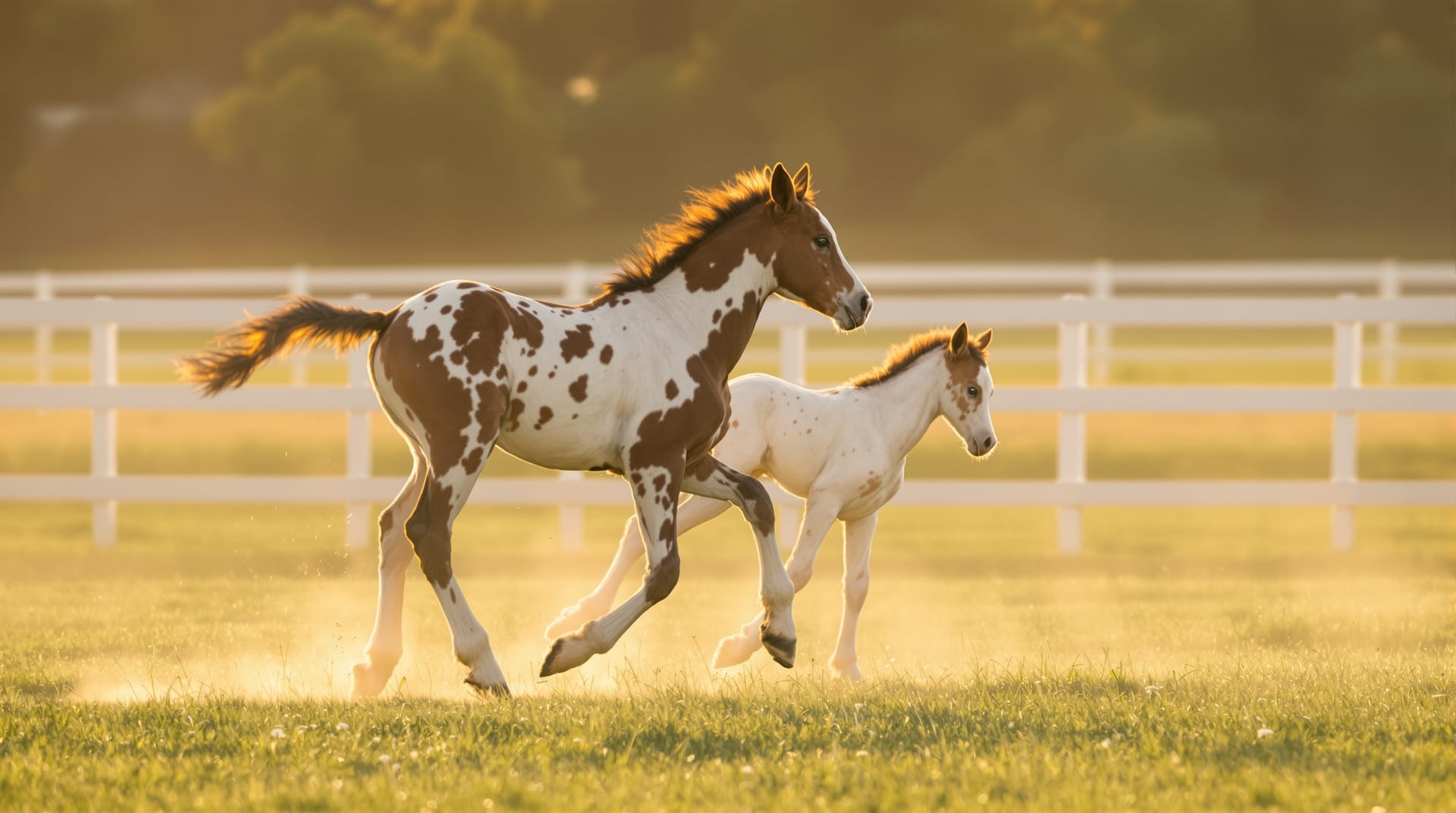
The two years between weaning and a first season under saddle determine more about a horse's eventual career than anything that happens afterwards. They are also the years in which the least is visible: a weanling gives away far less about its adult self than owners want to believe, and the industry's habit of pricing young stock on present appearance leads reliably to disappointment on both sides of the sale.
Growth Is Uneven and That Is Normal
Young horses do not grow proportionally. They grow in stages, often lifting at the croup first and then filling at the shoulder, so that the same animal can look downhill at ten months, level at fifteen, and downhill again at twenty. A yearling photographed at the wrong point in that cycle looks structurally faulty and is not.
The practical consequences are two. Assess a young horse repeatedly over months rather than once, and be extremely cautious about paying a premium for the appearance of a weanling — you are buying a stage, not a conformation. Balance in a young horse is best judged by the relationships that do not change much: the slope of the shoulder, the set of the neck into the shoulder, the length of the hip and the correctness of the legs. Those are worth studying on our conformation page.
Nutrition and the Cost of Pushing
Feeding young horses is where enthusiasm does the most damage. Rapid growth pushed by heavy concentrate feeding is associated with developmental orthopaedic problems, and the animals most at risk are precisely the ones being prepared for early show careers. Steady, moderate growth on a balanced ration produces sounder adults than accelerated growth produces impressive yearlings.
Work with your veterinarian and, where the situation is complex, an equine nutritionist. Land-grant university extension services publish free, evidence-based guidance on growing horse nutrition; material from institutions such as Penn State Extension is a reasonable place to start reading before the conversation. Forage quality, mineral balance and growth rate monitoring matter more than the brand on the bag.
Handling — Little and Often
The foundation laid in these years is behavioural. A young horse should learn, in unhurried increments, to be caught, haltered, led, tied, groomed, have all four feet handled, load and unload calmly, stand for the farrier and the veterinarian, and accept clipping and bathing. None of this is training in the competitive sense and all of it determines whether the eventual training goes well.
Short, frequent and consistent sessions beat long ones. The single most valuable habit is finishing while the horse is still comfortable, which builds a young animal that expects handling to be uneventful — the temperament every amateur buyer says they want and few are willing to wait for.
Hoof Care and Early Intervention
Regular farrier attention from the first months is not cosmetic. Minor angular deviations in a growing limb can often be influenced while the growth plates are still open, and the window for doing so is measured in months. A farrier and veterinarian working together during the first year can resolve issues that would be permanent by the second. Establish the schedule early and keep it even when nothing appears wrong.
Turnout and Company
Young horses need movement and they need each other. Turnout builds bone density and coordination that stall time cannot, and running with other youngsters teaches the social calibration that makes a horse manageable later. The instinct to protect a valuable prospect by confining it produces a physically weaker and behaviourally worse adult. Sensible fencing and appropriate company are worth more than a bigger stall.
A Realistic Timeline
- Weanling year — handling foundation, growth monitoring, farrier and deworming schedule established, minimal formal work.
- Yearling year — continued handling, in-hand work, exposure to clipping, hauling and new environments; in-hand show classes if the horse is mature enough to cope, not because the calendar says so.
- Two-year-old year — introduction to work under saddle where the individual's physical maturity supports it, in short sessions with long recovery.
- Three and onward — the beginning of a competitive programme, at a pace set by the horse.
The timeline is a guide and not a schedule. Individuals mature at different rates, and the difference between a horse that competes at four and one that competes at five is far less consequential than the difference between one that stays sound and one that does not.
Colour Along the Way
Expect pattern to change throughout, sometimes dramatically. Roaning progresses, spots appear and diffuse, and a weanling's coat is a poor predictor of a five-year-old's. The coat pattern page explains why, and it is the main reason to buy a young horse for its structure and its temperament rather than for how it photographs at six months.